Deafblindness is a unique disability that is under-researched and therefore poorly understood by professionals, policymakers and the wider public. Globally, individuals living with deafblindness are reported to be the most affected by daily barriers, and at highest risk of poverty and exclusion.
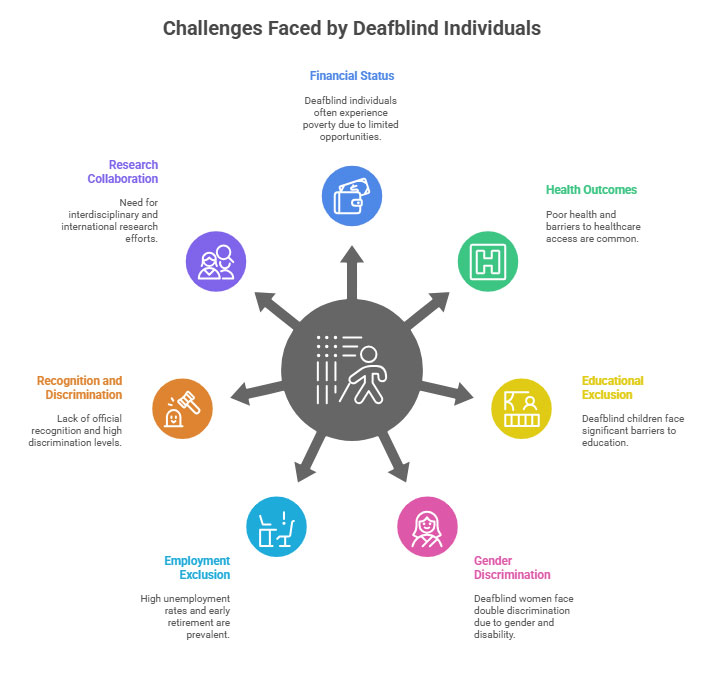
There are urgent calls for more robust research evidence to inform policy and practice, and for greater international and interdisciplinary collaborations to advance the rights and inclusion of people living with deafblindness. Most research on deafblindness comes from the Global North, and we urgently need more research on deafblindness in the Global South, to better understand how the impairment interacts with multiple factors, such as poverty and social inequality.
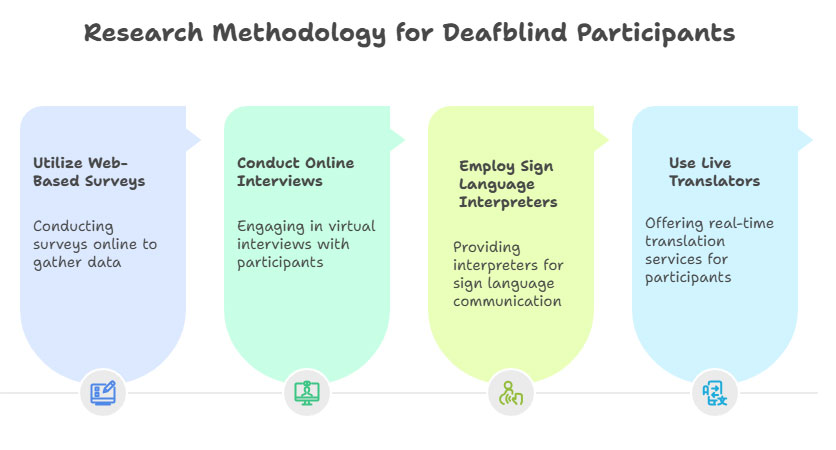
We will explore the experiences of adults with congenital or early-onset deafblindness, who may have finished compulsory/formal education, and/or might have had some experience of employment, and/or further studies. We will elicit their views about various aspects of their lives, including their access to education, healthcare, rehabilitation and social services. And lastly, we will collect data using an accessible web-based survey and interviews with deafblind people. Data will be analyzed using descriptive statistics and Framework Analysis.
Examples Of How This Can Be Put into Practice:
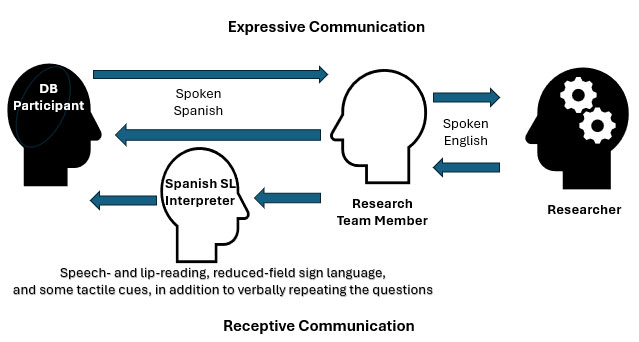
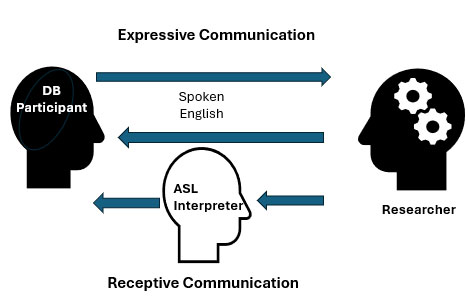
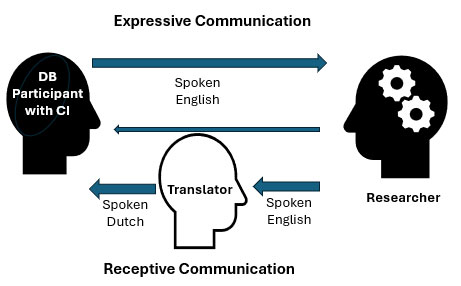

The findings will subsequently inform the development of a large-scale collaborative international project that will result in concrete policy recommendations. The main intended outcome of this project is to provide a tangible contribution towards the achievement of the international community’s agreed Sustainable Development Goals, including SDG3 (global goal for Health and Wellbeing), SDG4 (Education) and SDG10 (reduced inequalities).
Our project objectives are:
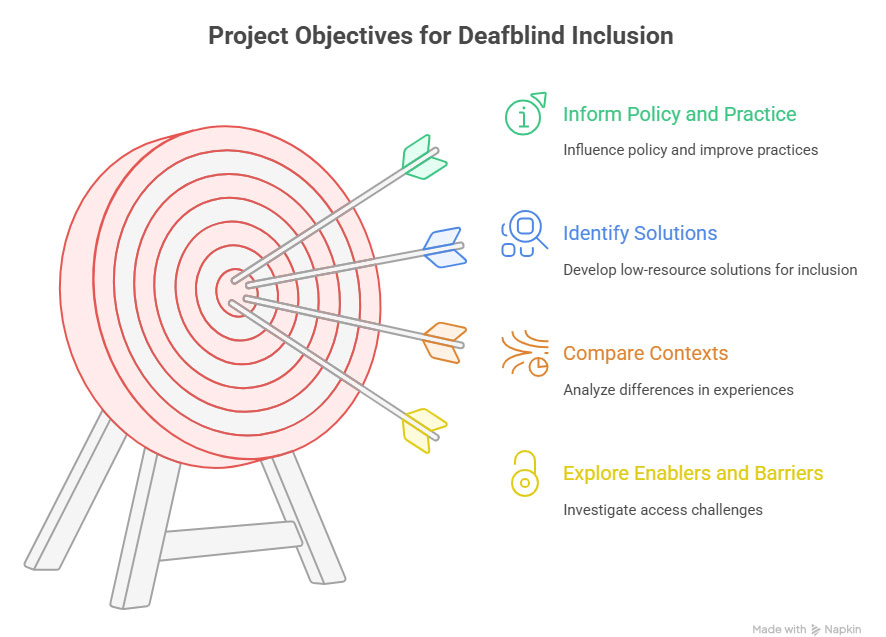
- To explore the enablers and barriers for people who are deafblind whilst accessing and navigating the education, healthcare and social services systems across the GS and GN.
- To compare the enablers and barriers in GS with those in the GN, to ascertain commonalities and differences across contexts and the role of local contextual factors in how deafblindness is experienced.
- To identify low resource solutions that can be applied in both the GN and GS for easier access and greater inclusion of people with deafblindness in the various systems.
- To inform local, national and international policy making, research and practice.
Progress Update
We have already begun conducting interviews with participants from across the globe.
https://www.google.com/maps/d/edit?mid=16cFOBLpboEg1KjM_K3uXMRYTH1reO2U&usp=sharing
Interactive Map
More Information Surrounding the Project
Conference presentations:
Wittich, W., Boie, N.R., Kamenopoulou, L., Simcock, P & Prain, M. (May 8th 2025). Conducting remote research with individuals living with deafblindness, Uncommon Senses V – Sensing the Social, the Environmental, and Across the Arts and Sciences, Concordia University, Montreal, QC
Book Chapter:
Kamenopoulou, L., Simcock, P., Boie, N.R. & Wittich, W. (2025). Exploring education and employment facilitators in low- and middle-income countries: Remote research with deafblind adults, in Hartshorne, T.S., Janssen, M., & Wittich, W. (Eds.) Learning, education and support of deafblind children and adults: An interdisciplinary lifespan approach, Oxford University Press, Oxford, England, DOI: 10.1093/oso/9780192887221.003.0016
Recruitment video on YouTube channel:
Principal Investigators

Walter Wittich
E-mail: SHOW EMAIL
Institution: School of Optometry, Université de Montréal

Peter Simcock
E-mail: SHOW EMAIL
Institution: Birmingham City University, UK

Leda Kamenopoulou
E-mail: SHOW EMAIL
Institution: University College London, UK

Natalina Martiniello
E-mail: SHOW EMAIL
Institution: School of Optometry, Université de Montréal
Collaborators

Serge Maynard
E-mail: SHOW EMAIL
Institution: Centre de réadaptation Lethbridge-Layton-Mackay du CIUSSS du Centre-Ouest-de-l’Île-de-Montréal

Cloe Rodrigue
E-mail: SHOW EMAIL
Institution: Institut Nazareth et Louis-Braille du CISSS de la Montérégie-Centre

Nora Groce
E-mail: SHOW EMAIL
Institution: Humanitarianism and Disability, Faculty of Population Health Sciences, University College London
Liz Duncan
E-mail: SHOW EMAIL
Institution: Learning, Assessment and Research, Deafblind UK

Katerina Bezerianou
E-mail: SHOW EMAIL
Institution: Panhellenic Association of Deafblind People-Parents, Tutors and Friends of Deafblind Children, THE HELIOTROPΕ

Akhil S. Paul
E-mail: SHOW EMAIL
Institution: Sense International India

Jennifer Robbins
E-mail: SHOW EMAIL
Institution: Canadian Helen Keller Centre

Renu Minhas
E-mail: SHOW EMAIL
Institution: DeafBlind Ontario Services

Ismael K. Byaruhanga
E-mail: SHOW EMAIL
Institution: Centre for Education and Community Based Rehabilitation (Centre d’Education et de Readaptation a Base Communautaire), Republic of the Congo

Mirko Bauer
E-mail: SHOW EMAIL
Institution: Deafblind International, Tanne Swiss Foundation for Persons with Deafblindness

Samuel Valencia
E-mail: SHOW EMAIL
Institution: World Federation of the Deafblind, Bogota, COLOMBIA

Atul Jaiswal
E-mail: SHOW EMAIL
Institution: Post-doctoral fellow at the School of Optometry, Université de Montréal
Trainees & Staff

Shirley Dumassais
E-mail: SHOW EMAIL

Tshimanga Ariel Ndomba
E-mail: SHOW EMAIL

Norman Robert Boie
E-mail: SHOW EMAIL

Katharina Ulrich
E-mail: SHOW EMAIL

Claire Manford
E-mail: SHOW EMAIL

Georgia Prokopiou
E-mail: SHOW EMAIL
This study has been made possible thanks to the following organisations: